Eleodor Sotropa
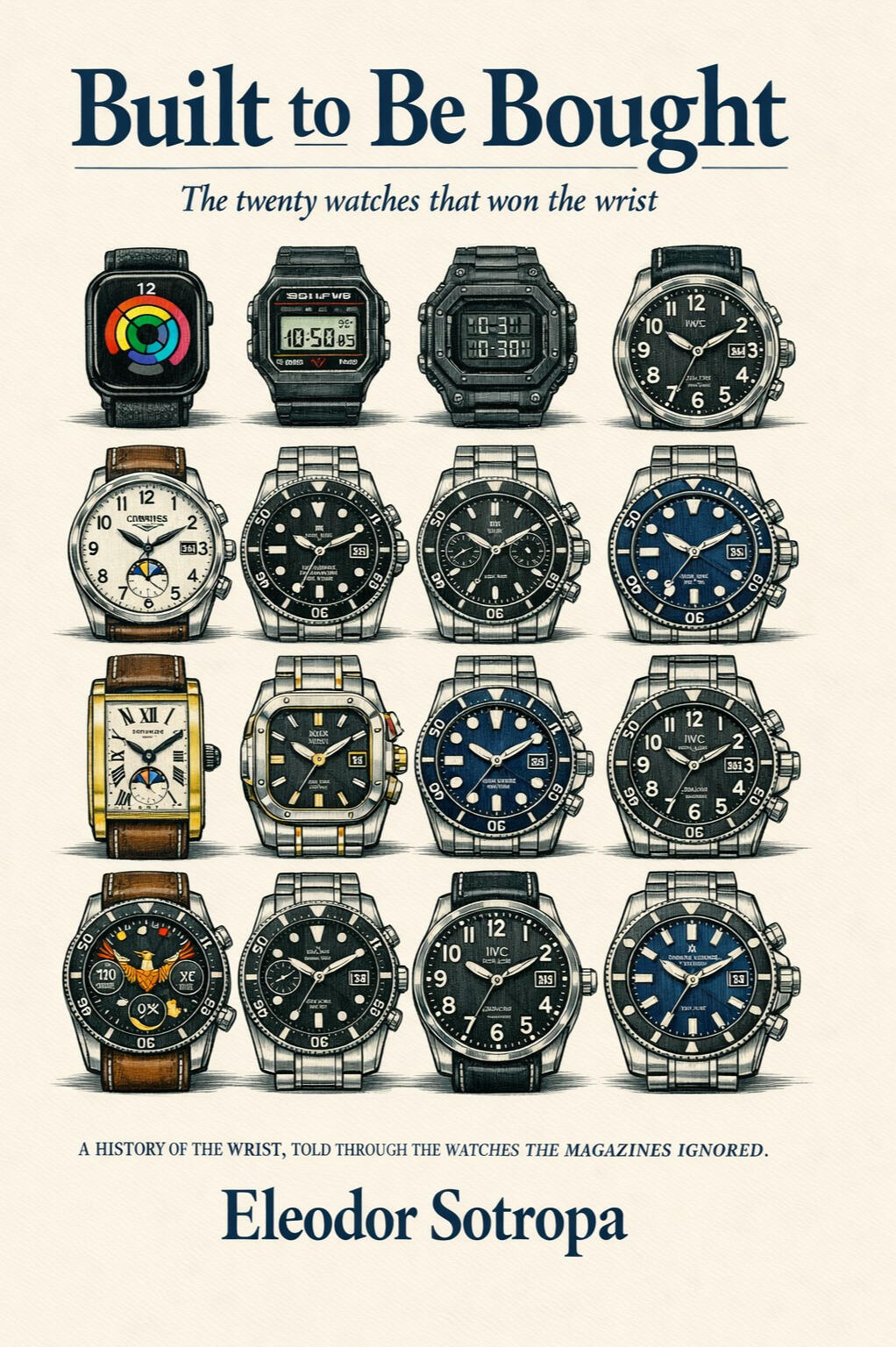
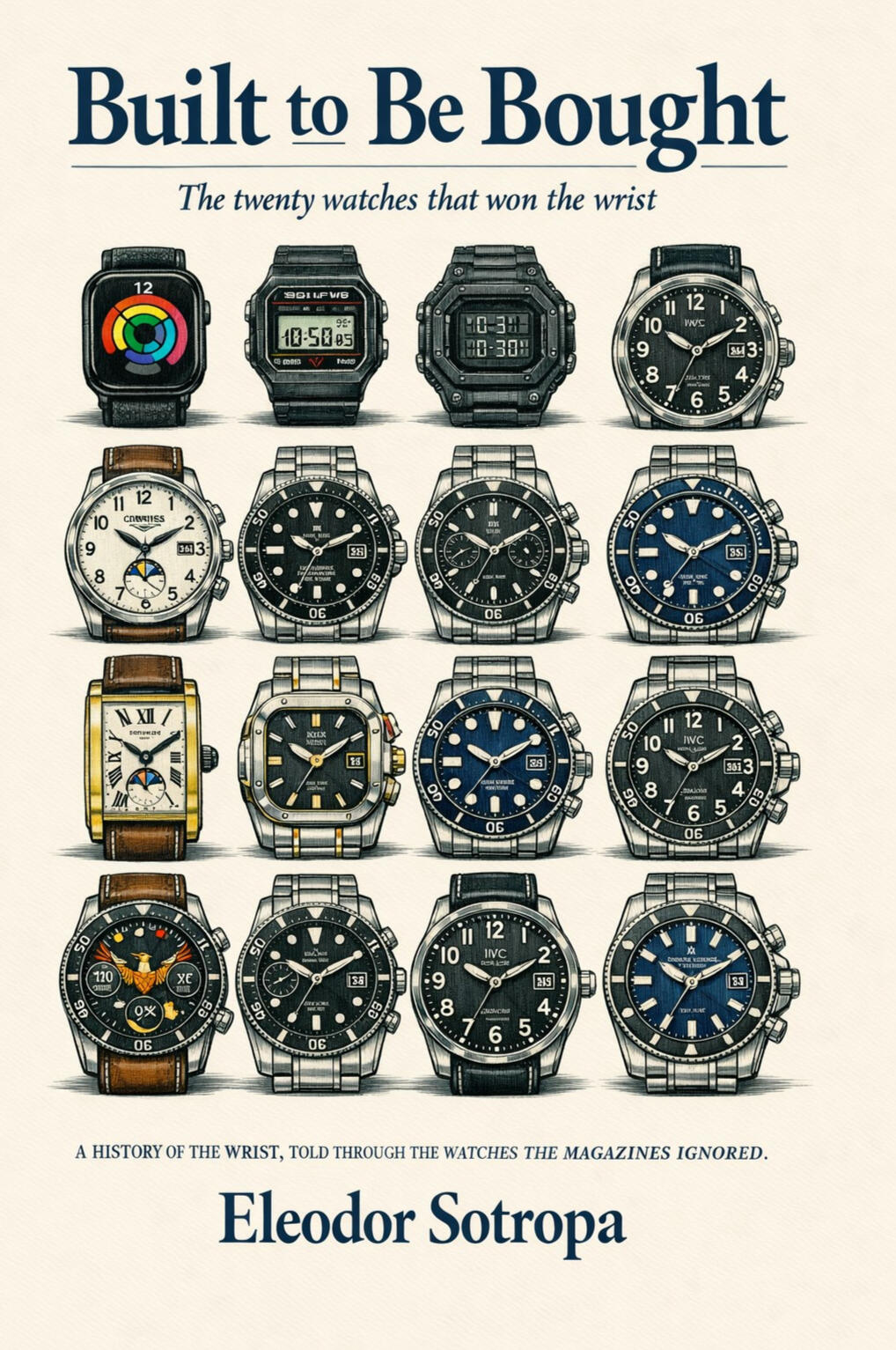
Built to Be BoughtThe twenty watches that won the wrist
The watches you've heard of are not the watches the world bought.
For every Submariner on a James Bond wrist, there are a hundred million Casio F-91Ws on the wrists of teenagers, soldiers, and accountants. For every Patek Philippe Nautilus on a waiting list, there are five hundred Apple Watches sold this quarter.
Built to Be Bought tells the real story of the wrist in twenty watches, chosen on one criterion: volume. Not prestige. Not pedigree. What people actually paid for.Twenty watches. One century. Ten billion wrists.
The watches that won.
What You Will Learn From The Book
You will learn why the watches that shaped the industry are not the ones you read about in glossy magazines. Built to Be Bought strips away the mythology and follows the money - the production numbers, the factory decisions, the retail strategies, and the engineering gambles that put a watch on a hundred million wrists instead of a hundred thousand.You will also learn to see a watch differently. Not as a luxury object or a fashion accessory, but as a product - one that had to survive a boardroom, a factory floor, a price war, and a shop window before it ever reached your wrist. Every chapter is a business story disguised as a watch story.


Why the cheapest watch ever made appears on more government watch lists than any luxury brand
How one overnight sketch on a hotel napkin created a category worth more than the rest of its company combined
What a bathroom-window drop test has to do with the most durable consumer product in history
Why Apple sold more watches in one year than Switzerland sold in twenty
How a $260 plastic collaboration crashed websites, circled city blocks, and broke every rule of luxury pricing
What happens when a great Swiss name accepts a smaller stage - and fills every seat in the house
Why the watch nobody wanted sat on shelves for a decade before generating an eight-year waiting list
Chapters
Built to Be Bought: The Twenty Watches That Won the WristThe watches you know by name are not the watches the world actually bought. For every Submariner on a collector's wrist, there are a hundred million Casio F-91Ws on the wrists of teenagers, soldiers, and accountants. For every Patek Philippe on a waiting list, there are five hundred Apple Watches sold this quarter. Built to Be Bought tells the real story of the wristwatch in twenty chapters, chosen on one criterion: volume. Not prestige. Not pedigree. What people actually paid for. This is a history of the wrist, told through the watches the magazines ignored.Preface - The Wrist as Marketplace
Before the first chapter begins, a question: what if everything the watch press told you about which watches matter was wrong? The Preface lays out the book's premise - that the twentieth century's most successful personal object is not the car or the smartphone but the wristwatch, and that the real story belongs to the models that sold in the millions, not the ones that sold at auction.Chapter 1 - Apple Watch
A health sensor disguised as a fashion accessory, the Apple Watch shipped more units in a single year than the entire Swiss watch industry combined. This is the story of how Cupertino killed the quartz watch and rebuilt it as a computer - and why the Swiss never saw it coming.Chapter 2 - Casio F-91W
It costs less than a sandwich. It has appeared on the wrists of presidents and on terror watch lists. The F-91W is the most widely worn watch in human history, and no one at Casio's headquarters can tell you exactly how many they have made. This chapter follows the world's most anonymous bestseller from a Tokyo engineering lab to every continent on earth.Chapter 3 - Casio G-Shock
An engineer named Kikuo Ibe dropped a watch from a bathroom window and spent three years trying to build one that would survive. The G-Shock is the product of that obsession - a watch designed around a single catastrophic event, which went on to become the most durable mass-market object ever manufactured.Chapter 4 - Seiko 5
The watch that democratised the automatic movement. For decades, the Seiko 5 has been the first mechanical watch for millions of buyers worldwide - a reliable, unglamorous machine sold at a price point that made Swiss entry-level look extravagant. This is the story of the factory that outproduced Switzerland.Chapter 5 - Rolex Datejust
The Datejust is not the most famous Rolex. It is the most important one. Launched in 1945 with the first date window on a wristwatch, it became the template for every dress watch that followed - and the single model that funds Rolex's entire operation. This chapter traces how a date aperture became a commercial empire.Chapter 6 - Rolex Submariner
Before it was a status symbol, it was a tool for underwater demolition teams. The Submariner's journey from military-issue dive instrument to the most recognised luxury watch on earth is a story about marketing, James Bond, and the peculiar alchemy that turns a tool into a trophy.Chapter 7 - Swatch × Omega MoonSwatch
In March 2022, Nicolas Hayek Jr. overrode his own marketing department and launched a plastic Speedmaster for $260. The queues circled city blocks. The resale market exploded overnight. The MoonSwatch is the most disruptive product launch in modern watch history - a chapter about what happens when a luxury house deliberately breaks its own price floor.Chapter 8 - TAG Heuer Carrera
Jack Heuer designed the original Carrera on the back of an envelope, inspired by a Mexican road race. Sixty years later, his great-nephew's team redesigned it with a domed crystal that divided the internet. This chapter tracks the Carrera from a motorsport chronograph to a contested modern icon - and asks what happens when a heritage brand tries to stay young.Chapter 9 - Cartier Tank
Louis Cartier sketched a watch that looked like a Renault tank, gave it to General Pershing, and accidentally invented the dress watch. The Tank has been worn by more heads of state, movie stars, and literary figures than any other single model - not because it keeps good time, but because it looks like nothing else on a wrist.Chapter 10 - Cartier Santos
The first purpose-built wristwatch was not made for a soldier or a sailor. It was made for a Brazilian aviator who complained that he could not check his pocket watch while flying. The Santos is where the entire wristwatch industry begins - and its modern revival is the story of how Cartier learned to compete with sports-watch giants on their own turf.Chapter 11 - Tissot PRX
A forgotten 1978 quartz watch, quietly discontinued and forgotten for decades, was resurrected by a single Instagram post and became the bestselling Swiss watch under $500. The PRX is a case study in how the internet can rewrite a brand's fortunes overnight - and why the integrated bracelet became the most coveted silhouette of the 2020s.Chapter 12 - Omega Speedmaster
NASA did not choose the Speedmaster. The Speedmaster survived the test that every other watch failed. The Moonwatch's journey from a racing chronograph to the only watch certified for extravehicular activity is a story about luck, engineering, and the marketing campaign that wrote itself when Buzz Aldrin strapped one on over his spacesuit.Chapter 13 - Audemars Piguet Royal Oak
Gérald Genta sketched it the night before the Basel trade fair. The factory nearly refused to build it. The salesmen said no one would pay steel-watch money for a steel watch. The Royal Oak broke every rule of Swiss watchmaking in 1972 - and created a category that now accounts for more revenue than the rest of Audemars Piguet combined.Chapter 14 - Patek Philippe Nautilus
Genta again - this time for Patek Philippe, a house that had never made a sports watch and did not want to. The Nautilus was an orphan at launch, ignored for a decade, and quietly discontinued before a waiting list appeared that would stretch to eight years. This chapter is about the strange economics of a watch that nobody wanted until everybody did.Chapter 15 - Tudor Black Bay
Rolex built Tudor to be its affordable sibling - a brand that could sell the Rolex silhouette at half the price. The Black Bay 58 is the watch that proved the strategy worked, generating a secondary-market frenzy and an eighty-name waiting list at a single authorised dealer. This is the story of how a brand designed to be second-best became a first choice.Chapter 16 - Longines
Before the Swatch Group reorganised the Swiss industry, Longines was a manufacture that rivalled Omega. After it, Longines became something else - an elegance brand at a mid-range price point, selling more watches than most of its former peers combined. The Master Collection and the HydroConquest tell the story of what happens when a great name accepts a smaller stage and fills every seat.Chapter 17 - Huawei Watch
Banned from American shelves, locked out of Google services, and cut off from the semiconductor supply chain, Huawei still managed to ship one of the world's best-selling smartwatches. The Watch GT series is a lesson in building a global product under siege - and in how two weeks of battery life can beat an ecosystem.Chapter 18 - Samsung Galaxy Watch
Samsung made the only smartwatch with a physical rotating bezel - a mechanical input on a digital device. The Galaxy Watch is the story of Android's long war with Apple for the wrist, fought not with software but with a single piece of fluted steel that clicks when you turn it.Chapter 19 - IWC Pilot's Watch
The Mark XI was built to a Royal Air Force specification so exacting that no civilian would have paid for it. The Mark XX, seventy years later, is built to a marketing specification so refined that millions do. The IWC Pilot's Watch traces the arc from military contract to luxury lifestyle - and asks whether the watch remembers what it was built for.Chapter 20 - Vacheron Constantin Overseas
The oldest continuously operating watch manufacturer in the world spent two decades trying to build a sports watch that could compete with the Royal Oak and the Nautilus. The Overseas is the result - a watch that arrived late to a party it helped invent, and quietly became the connoisseur's choice over the louder names in the room.
About The Author
Eleodor Sotropa is a technologist, writer, and lifelong watch enthusiast based in Cincinnati, Ohio. By day he leads digital product teams. By night he reads production histories and argues about bezels on the internet.Built to Be Bought grew out of a simple question he could not find a good answer to: which watches did people actually buy? Not which watches won awards, or appeared in magazines, or sat in museum cases - but which ones sold in the millions, and why. The research took him from Casio's engineering archives to Patek Philippe's discontinued-reference lists, from Apple's Cupertino campus to the Swatch Group's factory floors in Biel.
The result is twenty chapters that treat the wristwatch not as a collector's trophy but as the twentieth century's most successful product.
When he is not writing or working, he is most likely wearing a watch that costs less than the book you are holding.